| Irian Jaya Tsunamis on January 3, 2009 |
We have simulated the tsunamis generated from the Irian Jaya earthquakes ( 1st event: 0.510°S, 132.783°E, Mw=7.6 at 19:43:54 UTC and 2nd event: 0.695°S, 133.279°E, Mw=7.3 at 22:33:42 UTC according to USGS ) on January 3, 2009. The assumed tsunami sources cover the aftershock area during one day after the mainshocks (Fig. 1). The fault sizes are 80 km × 40 km and 60 km × 30 km for the first and second events, respectively. Top depths of the faults are 10 km. The focal mechanism are strike=112º, dip angle =36º and slip angle= 77º for the first event, and strike=104º, dip angle =29º and slip angle= 76º for the second event from the USGS's CMT solutions. Average slips on the faults are 2 m and 1.3 m for the first and second events, respectively. As the initial condition for tsunami, static deformation of the seafloor is calculated for a rectangular fault model [Okada, 1985] using the source model. The used bathymetry data is 2' grid interval resampled from GEBCO 1' grid data. We also used regional bathymetry data around Japan, JTOPO30 and digital contour bathymetry data by JHA. To calculate tsunami propagation, the linear shallow-water, or long-wave, equations were numerically solved by finite-difference method [Satake, 1995]. The maximum heights of simulated tsunami indicate that the tsunami energy is concentrating to directions perpendicular to the strike of fault (Fig. 2). We have downloaded the tide gauge data from JCG's and compared the simulated tsunami waveforms and observed ones (Fig. 2). We can see the tsunami propagation to the coast of Japan (Fig. 3).
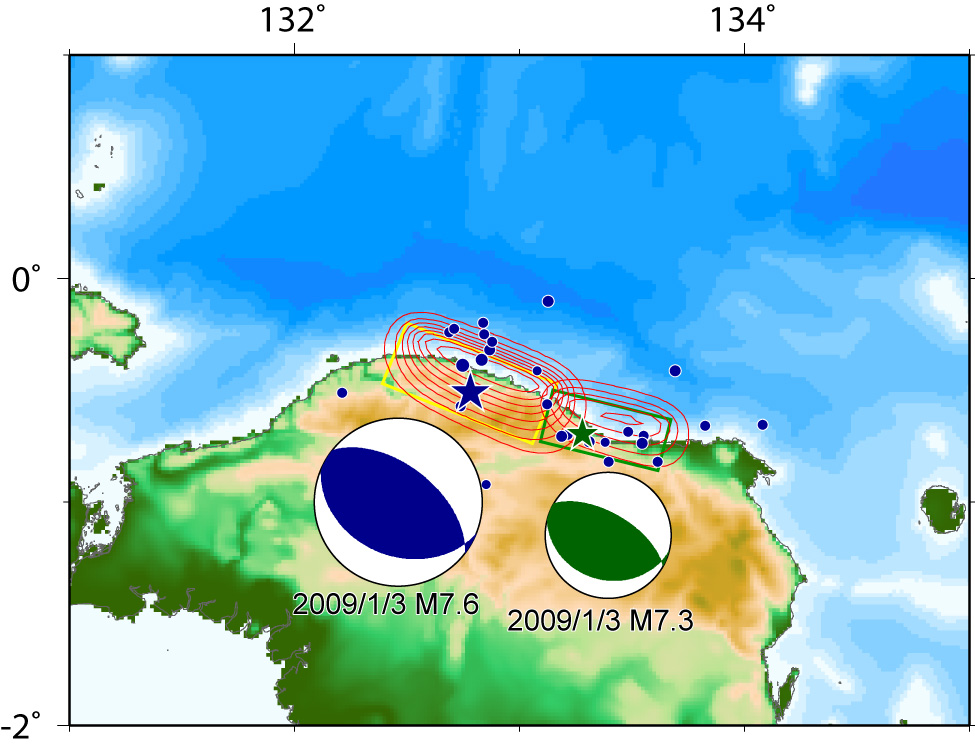
Fig.1 Tsunami Source Models
The red contours indicate uplift, while the blue contours indicate subsidence with the contour interval of 0.1 m.

Fig.2 Maximum Height of Computed Tsunami
Solid lines in red and blue indicate observed tsunami waveforms and synthtic ones, respectively.
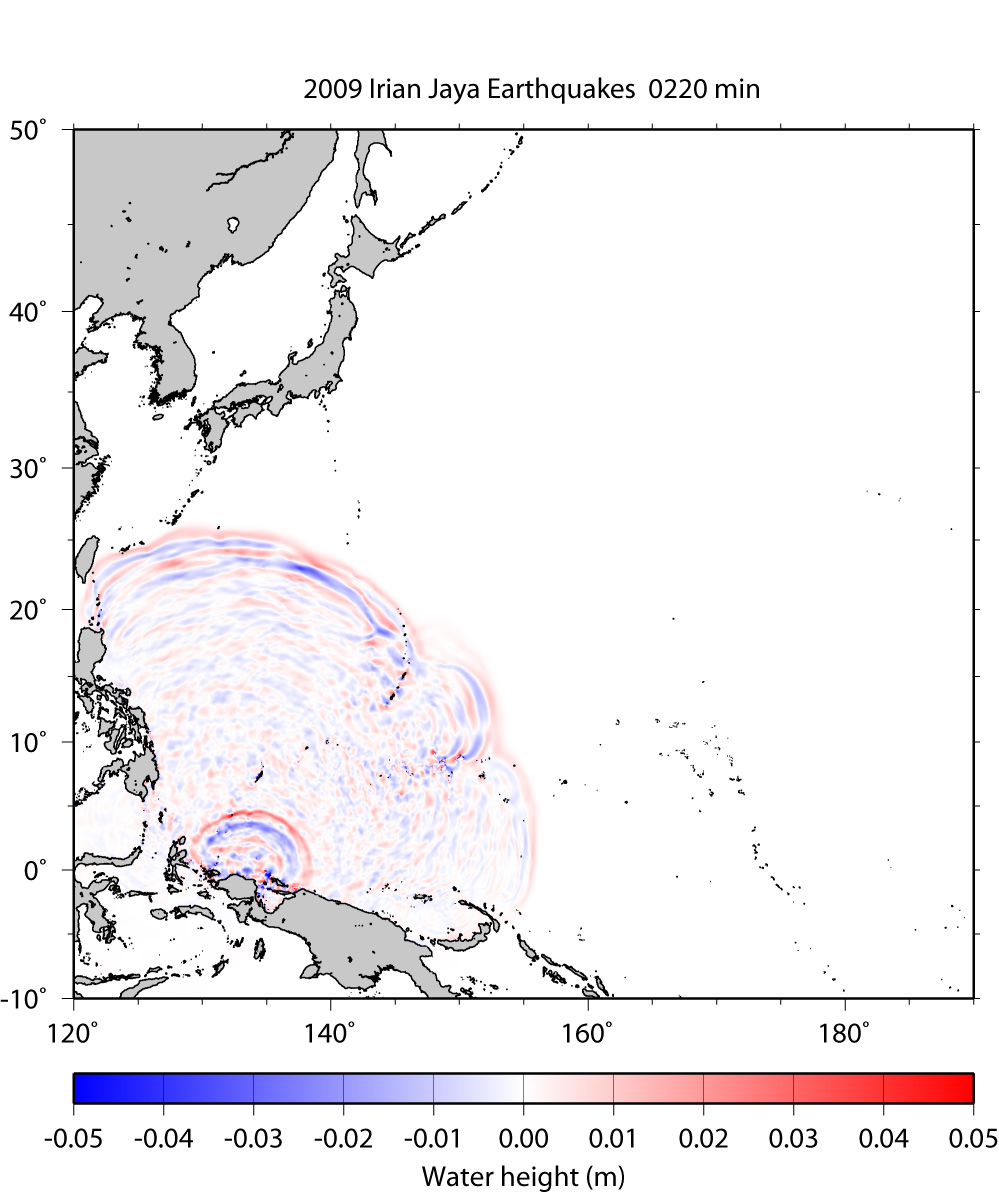
Fig.3 Tsunami Propagation (Click to start animation)
The red color means that the water surface is higher than normal sea level, while the blue means lower.
| by Yushiro Fujii (IISEE, BRI) and Kenji Satake (ERI, Univ. of Tokyo) |
|
|
| References |
|
Okada, Y. (1985), Surface Deformation Due to Shear and Tensile Faults in a Half-Space, Bull. Seismol. Soc. Am., 75, 1135-1154. Satake, K. (1995), Linear and Nonlinear Computations of the 1992 Nicaragua Earthquake Tsunami, Pure and Appl. Geophys., 144, 455-470. |
Last Updated on 2009/1/5