 VIEW ALL COURSES



All course view
Lecture note files of the courses with (♦) can be downloaded freely.
Lecture note files of the courses with (∗) can be sent to you by e-mail upon request.
The 2011 off the Pacific coast of Tohoku Earthquake
| Course ID# | Course Title | Days | Lecturer | Updated | Notes | |
|---|---|---|---|---|---|---|
| ♦ | P-010-2011 | Seismic and Tsunami Damage on Building Structures Caused by the 2011 Tohoku Japan Earthquake | 1 | Mitsumasa MIDORIKAWA... | 2012-02-22 | |
| ♦ | P-020-2012 | The 2011 Tohoku-oki earthquake and tsunami | 1 | Kenji SATAKE (Earthq... | 2012-12-07 | |
| ♦ | P-030-2011 | Damage of the Tsunami of the East Japan Earthquake of March 11th, 2011 along the coasts of the Kanto and Tohoku Districts | 1 | Yoshinobu TSUJI (Ear... | 2012-10-03 |
Joint Course
| Course ID# | Course Title | Days | Lecturer | Updated | Notes | |
|---|---|---|---|---|---|---|
| ♦ | SET-010-2011 | Orientation | 1 | Shoichi ANDO (IISEE)... | 2011-10-21 | |
| ♦ | SET-020-2011 | International Disaster Management Systems and Japanese Urban Disaster Management (Recovery cases of recent huge disasters in Japan and the World) | 2 | Shoichi ANDO (IISEE)... | 2011-10-21 | |
| ♦ | SET-040-2018 | Ethics and Literacy for Scientific Study | 1 | International Instit... | 2019-01-07 |
Seismology Course
 |
|
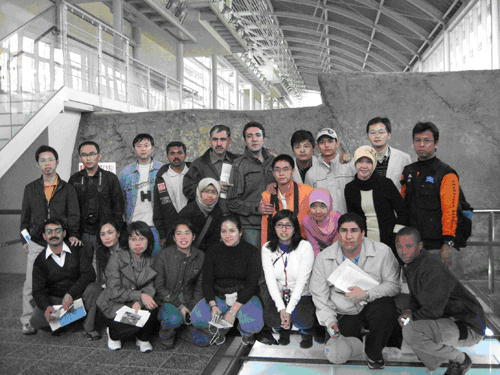
Visit to the Nojima Fault Preservation Museum |
This course aims to provide advanced knowledge and technology concerning earthquakes and seismic hazards to trainees who are invited from the organizations responsible for seismic observation and earthquake disaster mitigation in their respective countries. It is also designed to help trainees utilize this knowledge and technology for seismic hazard/risk evaluation and earthquake disaster mitigation policy-making in their native countries. The IISEE incorporates fast-evolving seismological knowledge and seismic observation technology into programs without delay, and is willing to provide not only classroom instruction but also practical training and study tours, as well as participation in international conferences.
| Course ID# | Course Title | Days | Lecturer | Updated | Notes | |
|---|---|---|---|---|---|---|
| ♦ | S0-020-2015(1) | Overview of Earthquake and Disasters | 1 | Takumi HAYASHIDA | 2016-12-20 | |
| ♦ | S0-030-2007 | Computer I | 4 | Tatsuhiko HARA (IISE... | 2011-05-20 | |
| ♦ | S0-030-2010 | Computer | 6 | Tatsuhiko HARA (IISE... | 2015-06-09 | |
| ♦ | S0-030-2015 | Computer | 9 | Takumi HAYASHIDA, Yu... | 2015-12-22 | |
| ♦ | S0-040-2007 | Computer II | 3 | Yushiro FUJII (IISEE... | 2009-03-11 | |
| ∗ | S0-050-2007 | Mathematics for Seismology I | 4 | Bunichiro SHIBAZAKI ... | 2009-04-15 | |
| ♦ | S0-070-2007 | Mathematics for Seismology III | 3 | Nozomu TAKEUCHI | 2009-01-01 | |
| ♦ | S0-090-2009 | Data Processing | 4 | Toshiaki YOKOI (IISE... | 2011-06-06 | |
| ♦ | S0-100-2010 | Theory of Seismic Waves | 7 | Nozomu TAKEUCHI ,Tak... | 2011-10-07 | |
| ♦ | S0-120-2009 | Surface Waves | 1 | Kiyoshi YOMOGIDA (Gr... | 2011-06-27 | |
| ♦ | S0-130-2009 | Scattering and Attenuation | 1 | Kiyoshi YOMOGIDA (Gr... | 2011-06-27 | |
| ∗ | S0-140-2007 | Numerical Simulation of Seismic Wave Propagation | 2 | Hiroshi TAKENAKA (Fa... | 2009-04-28 | |
| ♦ | S0-150-2007 | Earthquake Observation I | 3 | Toshiaki YOKOI (IISE... | 2011-06-06 | |
| ♦ | S0-170-2007 | Local Earthquake Analysis | 4 | Nobuo HURUKAWA (IISE... | 2011-06-20 | |
| ♦ | S0-190-2011 | Seismic Tomography | 1 | Dapeng Zhao (Tohoku ... | 2012-04-12 | |
| ♦ | S0-210-2007 | Observatory Practice | 2 | Kenji Kanjo, Kuninor... | 2011-06-27 | |
| ♦ | S0-220-2011 | Crust and Upper Mantle Structure | 2 | Takaya IWASAKI (Eart... | 2012-04-11 | |
| ♦ | S0-250-2013 | Moment Tensor Analysis | 2 | Yuji YAGI | 2015-03-17 | |
| ♦ | S0-260-2012 | Crustal Deformation | 2 | Takeshi SAGIYA | 2014-03-11 | |
| ∗ | S0-270-2009 | Earthquake Source Process | 3 | Keiko KUGE (Graduate... | 2010-06-14 | |
| ♦ | S1-090-2012 | Seismic Micro-Zonation (Remote Sensing Technology) | 1 | Masashi MATSUOKA | 2014-03-11 | |
| ♦ | S1-100-2010 | Strong Ground Motion Study II (Strong Motion Seismology) | 2 | Kojiro IRIKURA (Aich... | 2011-06-27 | |
| ♦ | S1-320-2014 | Microtremor Observation II | 1 | Takumi HAYASHIDA, Hi... | 2015-12-22 |
Earthquake Engineering Course
 |
|
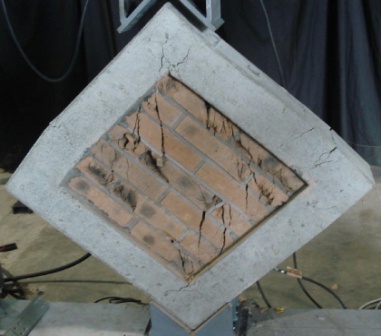
Fracture experimenti performed for participants |
This course provides training to participants who mainly consist of young researchers, engineers and administrative persons from government agencies and universities in their respective countries. Their training is geared towards contributing to the reduction of structural damage caused by earthquakes that can result in human suffering in developing countries. The curriculum comprises basic earthquake engineering studies, covering topics such as structural analysis and structural dynamics; various earthquake resistant structures for reinforced concrete construction, and steel structures; the latest technology, such as seismic isolation and response control technique and seismic limit state design. All of these are systematically provided through lectures, practical training and study tours, enabling trainees to solve problems in their native countries.
| Course ID# | Course Title | Days | Lecturer | Updated | Notes | |
|---|---|---|---|---|---|---|
| ♦ | E0-070-2007 | Finite Element Method: (A) Introduction | 3 | Taiki SAITO, Toshihi... | 2013-03-12 | |
| ♦ | E0-130-2007 | Structural Dynamics: (A) Introduction and Vibration Analysis | 5 | Izuru OKAWA (BRI), K... | 2011-06-27 | |
| ♦ | E0-190-2008 | Dynamic Soil Structure Interaction | 2 | Kenji MIURA (Hiroshi... | 2011-06-27 | |
| ♦ | E1-030-2007 | RC Structures III: Topic of the Recent Research on RC Structure | 1 | Masaomi TESHIGAWARA ... | 2011-07-06 | |
| ♦ | E1-060-2009 | Shaking Table Testing | 1 | Toshihide KASHIMA (I... | 2011-06-06 | |
| ∗ | E1-140-2009(1) | Earthquake Resistant Limit State Design I, II | 3 | Isao NISHIYAMA (BRI)... | 2010-05-25 | |
| ♦ | E1-140-2009(2) | Earthquake Resistant Limit State Design I, II | 3 | Hiroshi AKIYAMA (Nih... | 2010-05-25 | |
| ∗ | E1-160-2011 | Seismic Isolation | 2 | Masanori IIBA (BRI) ... | 2012-08-30 | |
| ♦ | E1-180-2011 | Design Earthquake Ground Motion and Seismic Force Ⅰ Ⅱ | 2 | Yuji ISHIYAMA (NewsT... | 2012-03-01 | |
| ♦ | E1-190-2010 | Structural Reliability | 2 | Jun KANDA (Universit... | 2011-06-28 | |
| ♦ | E1-200-2008 | Structural Response Control | 1 | Satsuya SODA (Waseda... | 2009-04-30 | |
| ♦ | E1-230-2009 | Strong Earthquake Motion Observation I, II | 2 | Toshihide KASHIMA (I... | 2011-06-06 | |
| ♦ | E1-240-2014 | Foundation Engineering II: Introduction to Building Foundations | 1 | Songtao XUE (Tohoku ... | 2014-02-06 |
Tsunami Disaster Mitigation Course
 |
|
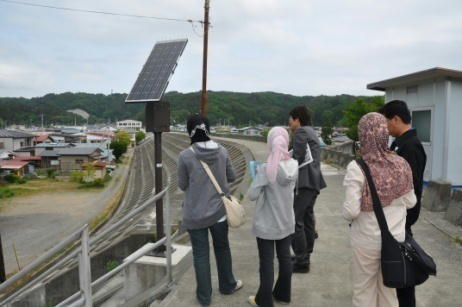
Visit to facilities for tsunami disaster prevention in Tohoku/Sanriku District |
The tsunami disaster mitigation course began in 2006. The gigantic tsunami that was generated by a major earthquake off Sumatran in 2004 wreaked havoc on the coastal regions of the Indian Ocean. To mitigate such tsunami disasters, it is necessary to take disaster mitigation measures based on the latest information regarding earthquakes and tsunamis. This course provides advanced education and technology for dealing with earthquakes and tsunamis, with the aim of training specialists who can apply and disseminate their acquired knowledge and techniques for tsunami disaster mitigation and introduce tsunami hazard evaluation and early-warning systems in their native countries. The initial target countries were coastal nations around the Indian Ocean, but since 2009 the scope of the course has been expanded to include countries around the Pacific Ocean.
| Course ID# | Course Title | Days | Lecturer | Updated | Notes | |
|---|---|---|---|---|---|---|
| ♦ | T0-010-2012 | Tsunami and Earthquake | 1 | Kenji SATAKE (Earthq... | 2012-12-07 | |
| ♦ | T0-040-2009 | Hydrodynamics for Tsunamis | 5 | Yoshinobu TSUJI (Ear... | 2012-10-03 | |
| ∗ | T0-060-2008 | Tsunami Source | 2 | Yushiro FUJII (IISEE... | 2009-05-11 | |
| ∗ | T0-080-2008 | Tsunami Simulation | 4 | Yushiro FUJII (IISEE... | 2010-12-09 | |
| ∗ | T0-090-2012 | Geology for Tsunami | 1 | Masanobu SHISHIKURA ... | 2014-02-25 | |
| ♦ | T0-100-2007 | Determination of Broadband Moment Magnitude | 1 | Tatsuhiko HARA (IISE... | 2012-09-19 | |
| ∗ | T1-080-2009 | Tsunami Damage Survey | 1 | Koji FUJIMA (Nationa... | 2010-02-03 | |
| ♦ | T1-080-2014 | Tsunami Damage Survey | 1 | Yoshinori SHIGIHARA | 2015-04-21 | |
| ♦ | T1-120-2012 | Tsunami Deposit Survey | 1 | Daisuke SUGAWARA | 2013-07-01 | |
| ♦ | T1-140-2011 | Numerical Simulation of Tsunami Inundation and Its Application | 2 | Hideaki YANAGISAWA (... | 2013-07-24 | |
| ∗ | T1-150-2012 | Tsunami Evacuation Planning and Simulation | 1 | Erick MAS | 2015-04-21 |
Global Seismological Observation Course
The international community is making efforts to put the Comprehensive Nuclear-Test-Ban Treaty (CTBT)into effect, and to complete the International Monitoring System (IMS) for CTBT-compliance verification. Observation technology using seismological techniques plays an important role in the IMS.
At the request of the Ministry of Foreign Affairs, the IISEE launched a global seismological observation training course in 1995 in cooperation with the Japan Metrological Agency and JICA as a part of Japan’s contribution to nuclear disarmament. The IISEE has contributed to the development of human resources who have acquired the skills necessary for detecting nuclear tests through seismic observation as well as the data analysis techniques required for identifying nuclear tests, and are expected to play important roles in the CTBT and IMS.
contents of the program
|  | ||
|
Wave patterns of nuclear tests (above) and natural earthquakes occurring near the testing sites (below) |
Lectures and practical training with regard to the use of seismometers |


| Course ID# | Course Title | Days | Lecturer | Updated | Notes | |
|---|---|---|---|---|---|---|
| ♦ | G-010-2009 | Guidance of the Training Course | 1 | Tatsuhiko Hara (IISE... | 2011-06-06 | |
| ♦ | G-030-2012 | Instrumentation and Observation (1) - Seismometer - | 2 | Toshiaki Yokoi | 2014-02-25 | |
| ♦ | G-080-2015 | Instrumentation and Observation (2) -Noise Survey and Site Selection- | 2 | Takumi HAYASHIDA | 2017-02-21 | |
| ♦ | G-090-2009 | Installation of LINUX and SAC | 1 | Tatsuhiko Hara (IISE... | 2011-06-06 | |
| ♦ | G-100-2009 | Introduction to UNIX | 1 | Yushiro Fujii (IISEE... | 2010-01-12 | |
| ∗ | G-110-2009 | Data Processing | 3 | Bunichiro Shibazaki,... | 2011-10-07 | |
| ♦ | G-150-2013 | Source Mechanism | 2 | Yuji YAGI | 2015-03-17 | |
| ∗ | G-180-2013 | Discrimination by mb-Ms | 1 | Akio Katsumata | 2015-03-12 | |
| ∗ | G-210-2009 | Geotool | 1 | Nobuo Arai, Takayuki... | 2010-03-15 |
China Seismic Building Course
 |
|
Group photo taken at the completion of the first lecture of the 2009 term |
On May 12, 2008, a magnitude 7.9 earthquake in Wenchuan, Sichuan Province in the People's Republic of China caused extensive damage, leaving 69,185 dead, 374,171 injured, 18,404 still missing and 23.143 million households damaged, including the collapse of 6.525 million houses. The BRI launched its China Seismic Building Course in October 2009 as part of the "Human Resource Development Project for Aseismic Buildings", carried out by JICA as a supportive reconstruction measure in response to the earthquake disaster in China. This is a two-month training course, and around 20 engineers participate in the course every year. Once their training is complete, engineers return to their respective countries to implement and disseminate their newly acquired technology and knowledge. The project aims to educate about 5,000 structural technology specialists over the course of three years. Short-term training courses focusing on specific themes such as this have been carried out since 1980. These are generically referred to as "Seminar Course".
| Course ID# | Course Title | Days | Lecturer | Updated | Notes | |
|---|---|---|---|---|---|---|
| ♦ | C-040-2010-CN | 抗震工学概论Ⅱ(钢筋混凝土框架的非线性分析) | 1 | 小谷 俊介 | 2015-03-12 | |
| ♦ | C-040-2011-CN | 结构反应论Ⅱ(钢筋混凝土框架的非线性分析) | 1 | 小谷 俊介 | 2011-07-06 | |
| ♦ | C-050-2011-CN | 结构反应论Ⅲ | 1 | 齐藤 大树 | 2011-07-06 | |
| ♦ | C-170-2011-CN | 国际防灾 | 1 | 安藤 尚一 | 2024-08-04 | |
| ♦ | C-220-2009-CN | 抗震结构特别讲义(钢混抗震结构特别讲义) | 1 | 小谷 俊介 | 2011-07-06 |